Blog | 07/17/26
You already have the data: finding the family caregivers who are cracking


The single most common reason I hear for why an organization hasn’t launched a caregiver program: “We don’t collect caregiver data.” It’s simple and to the point. But it’s also, mostly, wrong.
While it’s true that you might not have a tidy field labeled “caregiver” sitting in your systems or databases, that does not mean that you don’t have it. The signals that a caregiver — and the home around them — is under strain is almost certainly already sitting in your claims, call, and pharmacy data.
And not only is it sitting there, it’s likely telling a more powerful and actionable story than a singular “caregiver” field ever could. Because of the context.
Dr. Heidi Syropoulos made this case better than I can on our recent webinar and I’m here to put her framework on the page.
Don’t boil the ocean
Take a 10,000-member D-SNP as a working example. Roughly 55–65% of those members — call it 6,000 — have multiple chronic conditions, live in the community, and rely on a family member or friend as their caregiver.
When we dig deeper and stratify those 6,000 members, we’d typically find about 20% (roughly 1,200 households) where the caregiver is experiencing a high level of burden and the household unit as a whole is under stress as a result.
“You’re not building a high-touch program for 10,000 people. You’re using data you already have to find the 1,200 households where the situation is cracking.”
This reframe matters. A lot. Here’s why.
In addition to the misperception that they don’t have the data, the perceived size of the problem is what keeps organizations from even starting to build a program in the first place.
Start with suspecting intelligence
You don’t have to wait for perfectly clean and pristine caregiver data. Most of what you need is already standard — it’s sitting in your claims, pharmacy, and care-management records. Sitting there, telling a story that any healthcare organization needs to hear, and begging to be acted on.
And at Carallel, acting on it is what we do. We use a standard suspecting logic across a variety of dimensions: clinical acuity, utilization and care transitions, functional and pharmacy indicators, and documented signs that a caregiver is already in the picture. The best part? None of it requires a new data feed.
That’s the broad net: it tells you who likely has a caregiver. From there the five signals below tell you which of those homes is cracking right now. By the way, we’ve distilled the full model into a one-page clinical field guide and I’m glad to walk any plan through it. Just drop a comment or send me a dm.
Five signals already in your data
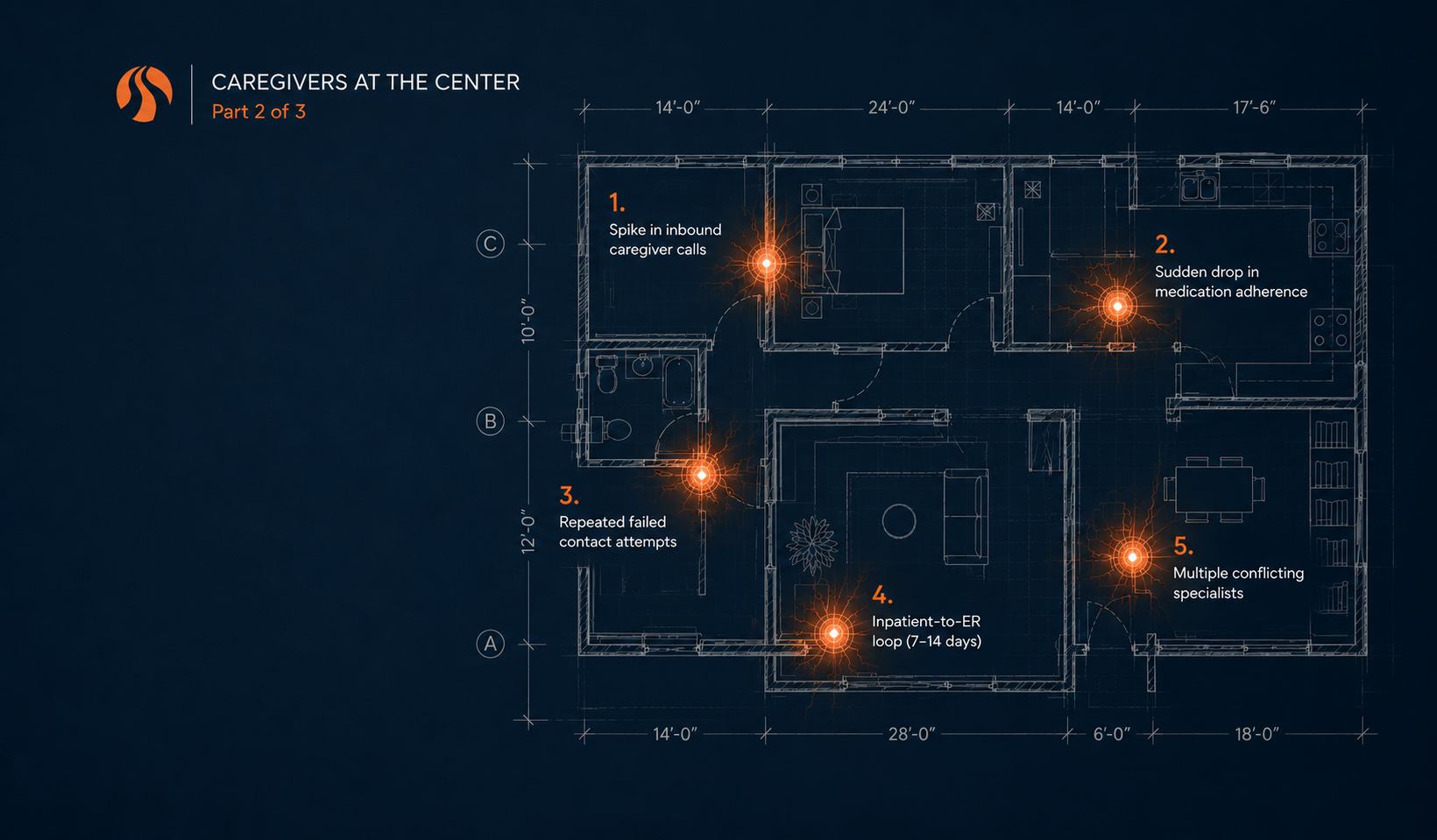
1. “Chasing” behavior in inbound calls. A sudden spike in calls from a third party on behalf of a member on very specific topics points to a caregiver navigating very high administrative friction, often near a breaking point.
2. A sudden drop in medication adherence. For example, when a member with advanced dementia or severe physical limitations sees their proportion of days covered on a maintenance drug suddenly fall, it’s rarely a member failure. It’s more likely a caregiver who’s too overwhelmed or financially strained to manage the regimen.
3. Repeated, failed contact attempts. Consecutive “unable to reach” notes suggest a caregiver too stretched to engage — or a household already in crisis.
4. The inpatient-to-ER loop. A member recently discharged from an inpatient stay who is back in the ED for an ambulatory-care-sensitive condition points directly to a breakdown in the home-care ecosystem.
5. Multiple, conflicting specialists. Multiple independent specialists with no clear primary-care anchor creates an exponential cognitive and logistical load on the family caregiver.
The logic travels and the stakes shift across industry segments
- In Managed LTSS, caregiver prevalence is even higher while failure is more immediate and expensive. The funnel is narrower at the top and the stakes higher at the bottom — losing an unpaid caregiver often triggers a costly level-of-care escalation the member never wanted.
- For Value-based provider groups, the signals are different including things like visit frequency, care-gap density, and social-risk flags. But the targeting logic is identical: find the households where unpaid support is fragile.
- And finally in PACE, you already know who the caregivers are. The question is whether you’re engaging them as partners or merely notifying them in a transactional fashion. There’s a massive difference between the two.
When it comes to building a program to support those caring for your members, participants, or patients at home–the work can feel big to start. There’s no question about that.
But ask any organization who’s invested the resources and capital to do so and they’ll tell you it’s worth it. Better yet, their company performance will tell you, too.
And it starts with a choice to listen to the story your data’s already telling.
Read Part 1 of this series:
The latest from Carallel

Caregiver Journey Webinar
A Caregiver Conversation by Carallel: Caring for Someone Living With Diabetes
We talk through the unique, and long-term, challenges of caring for someone who's living with diabetes....
Caregiver Journey Webinar
A Caregiver Conversation by Carallel: Smooth Transitions--Helping a Loved One Settle Into Assisted Living
We talk through the gravity of transitioning a loved one into a senior living community and offer tips for making the transition as smooth as...

Caregiver Journey Webinar
A Caregiver Conversation by Carallel: Caregiving & Chronic Illness--Tools for the Long Haul
We talk through the day-to-day realities of supporting someone with a long-term illness, the challenges that can sneak up over time, and simple,...